
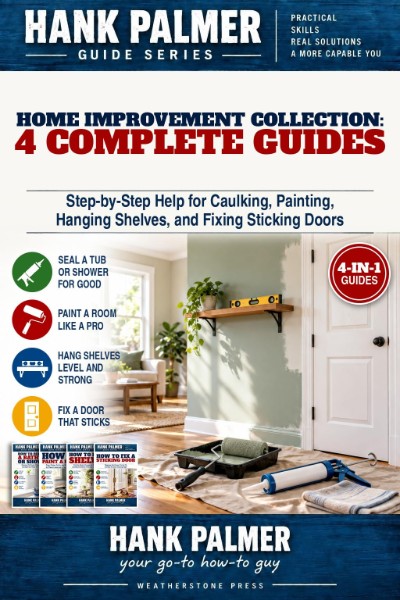
Want all four jobs, start to finish?
Some jobs fix something that’s broken. Others just make a room look finished: a clean seal around the tub, fresh paint with sharp lines, shelves that sit level, and a door that closes without a shove. These four are good first projects. None needs special skills, but each one has a step people skip that decides how it turns out.
1. Recaulk a Bathtub or Shower
New caulk over old caulk peels within weeks. Score and pull out the old bead, scrape the rest, and wipe the joint with rubbing alcohol until it no longer feels slick. Clean any mold, then let the joint dry overnight with the fan running.
Fill the tub with water right before you caulk, so the joint is at its widest when the bead goes on. Tape above and below the joint, run one steady bead per wall, smooth it once, and pull the tape while the caulk is still wet. Then follow the label’s cure time before anyone showers, or wait 24 hours if you’re unsure.
2. Paint a Room
Most of a good paint job happens before you open the can. Fill holes, sand, clean the walls, and prime patches and stains. If the house was built before 1978, test for lead before you sand or scrape anything.
Paint the ceiling first, then the walls, then the trim. On each wall, cut in the edges with a brush and roll it right away while the edges are still wet, so you don’t get visible bands. A gallon covers about 350 to 400 square feet, and most rooms need two coats. How much paint to buy for your room.
3. Hang Shelves
A shelf is only as strong as what holds it to the wall. Find the studs and confirm each one with a thin nail or small bit. Scan for wires and pipes first, and never drill directly above or below a switch or outlet.
In a stud, use #8 or #10 screws that go at least 1¼ inches into the wood. Where there’s no stud, use toggle bolts for anything with weight, not plastic anchors. Mark a level line instead of measuring up from the floor, and press down hard on the front edge before you load the shelf.
4. Fix a Sticking Door
Don’t reach for the plane first. Open and close the door slowly to find exactly where it rubs, and look at the gap around the door for spots that are wider or tighter than the rest. Most sticking doors have loose hinge screws, and tightening them pulls the door back into place.
Repair any stripped screw holes, then line up the strike plate once the door hangs right. Only if it still rubs after that should you sand or plane, and then only the high spot you marked. Prime and paint any bare wood so it doesn’t swell again.
When to Call a Pro
- A soft wall, loose tiles, or water stains below or behind the tub
- Old paint that may contain lead and can’t be tested or handled safely
- Hitting metal, a pipe, or a wire while drilling
- Several doors sticking at once, or a frame that’s visibly moving
- Wood around the hinges or jamb that’s split, soft, or rotten
My Home Improvement Collection puts all four guides in one book, each one step by step.
Get the full collection: Home Improvement Collection: 4 Complete Guides by Hank Palmer, on Amazon



Leave a Reply