
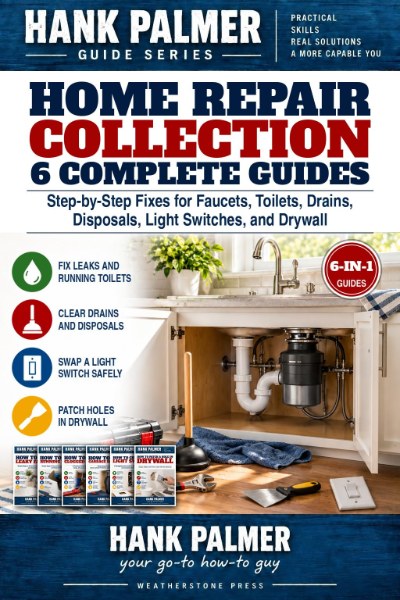
Want all six jobs, start to finish?
Most small home repairs don’t need a pro. They need the right part, a few basic tools, and someone to show you the order to do things in. Here are six of the most common ones, and what usually fixes each.
Start With a Basic Kit
- Adjustable wrench and pliers
- Phillips and flat screwdrivers
- A sink plunger and a flange plunger for the toilet
- Putty knife and utility knife
- Non-contact voltage tester
- Flashlight, bucket, and old towels
1. A Dripping Faucet
A drip almost always means a worn washer, O-ring, or cartridge inside the handle. Shut off the valves under the sink, plug the drain so small parts can’t fall in, and take the old part to the store to get an exact match. More on why faucets drip.
2. A Running Toilet
The usual cause is a flapper that no longer seals or a fill valve set too high. To check the flapper, add a few drops of food coloring to the tank and don’t flush for at least 15 minutes. Color in the bowl means the flapper is leaking. How to find and fix the cause.
3. A Clogged Drain
Pull the stopper and clear any hair first. Then plunge, covering the overflow hole on a bathroom sink so the pressure goes down the drain. If that doesn’t clear it, use a hand drain snake. Skip chemical drain cleaners. They can damage pipes, and they can splash back on you if you end up plunging anyway.
4. A Jammed Garbage Disposal
If it hums but won’t spin, something is stuck. Turn it off and cut the power before anything else, and never put your hand inside. Turn the hex socket on the bottom with the wrench that came with the disposal (most take a 1/4-inch hex key), then press the reset button. The full jam-clearing steps.
5. A Worn-Out Light Switch
Turn off the breaker, then confirm the power is off with a voltage tester before you touch a wire. Take a photo of the wiring before you disconnect anything, and buy the same kind of switch: a single switch and a three-way switch are wired differently. Signs a switch is going bad.
6. A Hole in the Drywall
Nail holes need only spackle. For a doorknob-size hole, cover it with a self-adhesive mesh patch, spread thin coats of joint compound, feather the edges, then sand, prime, and paint. Bigger holes need a new piece of drywall cut in. How to patch a doorknob hole.
When to Call a Pro
- Water you can’t shut off, or a leak inside a wall or ceiling
- A switch or outlet that’s warm, buzzing, scorched, or smells like burning
- Sewage backing up into more than one drain
- Any job where you’re unsure the power or water is really off
My Home Repair Collection puts all six guides in one book, each one step by step.
Get the full collection: Home Repair Collection: 6 Complete Guides by Hank Palmer, on Amazon



Leave a Reply