
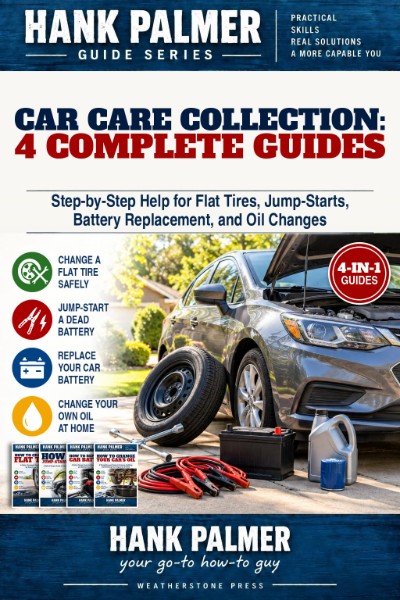
Want all four jobs, start to finish?
Every driver eventually meets the same four jobs: a flat tire, a car that won’t start, a battery that’s done, and an oil change that’s come due. None of them takes special skill. Each one has a few steps people skip, and those steps decide whether the job goes smoothly or turns into a bigger problem.
Keep a Basic Kit in the Car
- A spare tire you’ve checked, plus the jack, lug wrench, and any wheel-lock key
- A tire pressure gauge
- Jumper cables or a charged portable jump starter
- Gloves, safety glasses, and a flashlight
- Your owner’s manual
1. Change a Flat Tire
Get to a safe, firm, level spot away from traffic first. Turn on the hazard lights, set the parking brake, and check the owner’s manual for the jacking point. Loosen each lug nut slightly while the tire is still on the ground, then lift only high enough to swap the wheel.
Start every nut by hand, snug them in a star pattern, lower the car, and tighten them fully. Check the spare’s pressure and its speed and distance limits before you drive on. What to do when lug nuts won’t come off.
2. Jump-Start a Car
The order of the clamps matters. Red goes on the dead battery’s positive terminal, then the other red on the good battery’s positive. Black goes on the good battery’s negative, and the last black clamp goes on a bare metal ground point on the dead car, away from the battery. Take them off in reverse order.
Never jump a battery that’s cracked, leaking, swollen, or frozen. And once the car starts, find out why the battery was low. More on the jumper cable order.
3. Replace the Battery
Test the battery before you buy a new one, and check the manual: some cars need their settings saved or the new battery registered. Disconnect the negative cable first and the positive second. Put the new battery in and clamp it down before you connect anything, then reconnect positive first and negative last. Take the old battery back for recycling. Signs your car battery is dying.
4. Change Your Own Oil
Look up the oil grade, how much your engine holds, and the filter in the owner’s manual before you buy anything. If you need to lift the car, use ramps or jack stands. Never get under a car held up only by a jack.
Make sure you’ve found the engine oil drain plug and not the transmission plug. Put the plug back with a new washer, oil the new filter’s gasket, and pour in most of what the manual lists, then top up to the full mark on the dipstick. Start the engine, check for leaks, and take the used oil to a collection point. How often to change your oil.
When to Call for Help
- The car is in or close to moving traffic, or the ground is soft or steep
- The spare, jack, jacking point, or wheel-lock key can’t be found or doesn’t fit
- The battery is cracked, leaking, swollen, or frozen
- You see smoke, sparking, or strong heat from the battery or wiring
- The car needs a battery registration or procedure you can’t complete
My Car Care Collection puts all four guides in one book, each one step by step.
Get the full collection: Car Care Collection: 4 Complete Guides by Hank Palmer, on Amazon



Leave a Reply